Why I love the KJV Bible
When I think about my blessings
I have much to be thankful for
My life has been filled with happiness
I couldn’t ask for more.
Why I love the KJV Bible
When I think about my blessings
I have much to be thankful for
My life has been filled with happiness
I couldn’t ask for more.
Tell us about one thing (or more) that you promised yourself you’d accomplish by the end of the year. How would you feel once you do? What if you don’t?
http://dailypost.wordpress.com/dp_prompt/great-expectations/
My goal has always been to be a better reader. In college I wanted to read the assigned books with discernment, but ended up skimming to find required information. I made good grades, so continued that “skimming” habit far too long. Now my goal is to read more and genuinely search into what I read–dig deeper and mine the gold nuggets. This would especially apply to my Scripture reading.
A domestic goal is to finish a quilt for each of my children and grandchildren–surely not all of them this year, but at least one a year. Most quilters quilt so their offspring have a remembrance of them, but my quilts are geared to a specific need the receiver has or to a specific memory. I have been trying to make the patterns fit the person so that they would be timeless. A sample of my work and philosophy may be found here:
http://www.oldpaths.com/Archive/Johnson/Edna/Elizabeth/1939/quilting.html
If I am blessed with good health, I hope to continue my present schedule, following my husband everywhere. It is easy to see that human lifespan is limited and life is too short to miss a minute with my mate.
How often have you read the scripture about widows in the Lord’s church? How many women do you know who fit that description?
Honour widows that are widows indeed. But if any widow have children or nephews, let them learn first to shew piety at home, and to requite their parents: for that is good and acceptable before God. Now she that is a widow indeed, and desolate, trusteth in God, and continueth in supplications and prayers night and day. But she that liveth in pleasure is dead while she liveth. And these things give in charge, that they may be blameless. But if any provide not for his own, and specially for those of his own house, he hath denied the faith, and is worse than an infidel. Let not a widow be taken into the number under threescore years old, having been the wife of one man, Well reported of for good works; if she have brought up children, if she have lodged strangers, if she have washed the saints’ feet, if she have relieved the afflicted, if she have diligently followed every good work (1 Tim 5:3-10).
According to the Lord’s commands, we should be careful to take care of such Christian women until the day they go to be with Him. They have proven themselves beyond a doubt and deserve to be like Anna in the Temple, who “served God with fastings and prayers night and day” (Luke 2:37).
Sometimes there are dedicated women who do not fit every description. They may be the only ones in their families who are dedicated to the service of the church. One such lady in India is R. Ammani. Her whole family was on the Roman Catholic register in Kerala, but Ammani was converted in the early 1980’s. She attended the Chennai Teacher Training School classes and became a faithful member of the Lock St. church. When we needed a teacher for the children’s class which met on a veranda of the original Anchorage building, she was the first to volunteer. She had nearly 100 little children which gathered there each Sunday for many years.
Later Ammani went to teach young girls in a Bible school established by another missionary brother south of here. She was able to do that work for some time before one of the preacher’s wives took her place. When she came back to Chennai, she often talked fondly of the young girls she met and learned to love there. Several of those young girls used to make special trips to Chennai to pay her a visit and tell of their marriages or of their new babies. There was a genuine rapport that could be observed by anyone.
Later, when we needed a helper in the kitchen at CTTS, sister Ammani was willing to work for us for pay. Previously, we had paid her nothing for all the work she had done. I am not sure how many years she has been engaged in the kitchen work, but she has been with the school a long time. She also graded Bible correspondence courses sent out in the Malayam language. She offered to help us in our secular school classes teaching illiterate village women skills to help them find jobs. She taught basket weaving, embroidery and crochet. Even while she was busy cooking the meals every day for our students, there would be a half dozen ladies gathered at her elbow to watch her cook and ask her questions about their craft work. At one point she crocheted a border around the communion cloth for our Lord’s Supper Table, and did not ask any pay. She often sent cooked food to our daughter when she was pregnant; trying to be sure she got good nutrition while she was carrying her children.
About 6 years ago, Ammani was diagnosed with stage 3 cervical cancer. She did not have surgery because the cancer had progressed too far, but she had chemo and radiation therapy and supposedly was cured. She recovered and was able to work again in her normal duties. Each year, she has gone for check-ups and had a good report, but last week she was told that she is terminal. She has had fluids drawn off her stomach and the test results show that the cancer has gone beyond treatment. I feel a deep sense of sadness at this news, as you might well imagine. Ammani has been a truly faithful friend and Christian worker at CTTS for many years. Her word was always her bond. Never once can I remember her telling me anything that I did not find to be true. She never spoke of anything unless she were absolutely sure she had her facts straight, and that was most comforting to me in a land of Cretians (Titus 1:12).
Ammani is nearing 76 years of age. Why has she worked so many years doing so many different things? One would expect that her children would support her after all these years, but they were not Christians. Two sons, whose wives left them, were living with her and had no jobs. They did not help with the housework nor pay bills. Sister Ammani had all the bills to pay and all the work to do at home besides. She endured much from an ungodly family who leached off her good nature. Often she cried about not being able to see her beautiful grandchildren because the mothers moved far away from the lazy husbands. Ammani’s home life was never pleasant, but she always had a smile on her face and she genuinely loved the Lord’s people.
Scripturally, sister Ammani deserved to be enrolled as a widow, but she never allowed herself to take something for nothing. She did what she could.
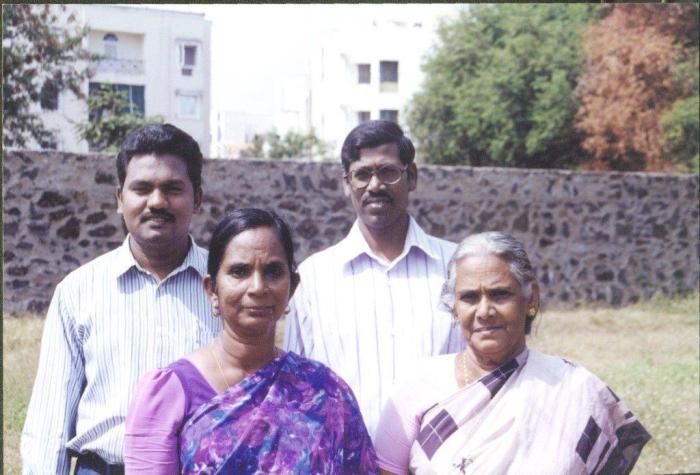
Correspondence Course Graders:
Front Row—left to right Shirley Mani (English); R. Amani (Malayalam)
Back Row—left to right K. K. Rao Mark (Telugu); G. S. Gnanaraj (Tamil)

The Bible does not mention the word “Gamble.” There are many principles that must be applied.
“But Saul and the people spared Agag, and the best of the sheep, and of the oxen, and of the fatlings, and the lambs, and all that was good, and would not utterly destroy them: but every thing that was vile and refuse, that they destroyed utterly” (1 Sam. 15:9).
Saul is one of the most tragic figures in the Old Testament. Head and shoulders above all the other men in Israel, he began his reign with great promise but ended it in shame.
“And he (Kish) had a son, whose name was Saul, a choice young man, and a goodly: and there was not among the children of Israel a goodlier person than he: from his shoulders and upward he was higher than any of the people” (1 Sam. 9:2).
As Israel’s first king, Saul had the opportunity to be an example for all future rulers, but his covetousness for the praise of men and for power over them, was his downfall.
Saul had other admirable physical qualities that made him fit to be received by Israel during the period immediately after the last judge. Because of his stature, he was quickly accepted by the people. Furthermore, the Lord used him as a good military leader, as shown by his victories early in his reign. Here we have a king who was not only is a warrior himself, but a man whose sons were also warriors. Note that his son Jonathan’s victory over the Philistines comes the first year after King Saul was anointed (1 Sam. 14:6-16).
One of Saul’s first sins was his failure to wait for Samuel at Gilgal (1 Sam. 13:8-9). The Philistines had gathered together against Israel with a large army and the Israelites had fled to hide themselves. Saul had to know if God wanted him to go to battle or not, and in order to approach God, he had to offer a sacrifice. There he assumed the role of a priest by making a sacrifice to ask for God’s blessing and to seek God’s counsel. His excuse for acting as a priest was totally unacceptable:
And Samuel said, What hast thou done? And Saul said, Because I saw that the people were scattered from me, and that thou camest not within the days appointed, and that the Philistines gathered themselves together at Michmash; 12 Therefore said I, The Philistines will come down now upon me to Gilgal, and I have not made supplication unto the LORD: I forced myself therefore, and offered a burnt offering” (1 Sam. 13:11-12).
He was willing to force himself to disobey God so he could win the people’s favor. Strangely, he determined to disobey God in order to persuade God to help him. Saul knew he had done wrong, but he justified his sin instead of following the law exactly (Lev. 3:5 and Lev. 6:9-13). There is no doubt in this incident that he knew that only the priests of God (descendants of Aaron) were to offer a sacrifice, and he knew Samuel’s purpose and promise was to do just that. So why is he so faithless in following a command of God he knows to do? He feared losing the people! He coveted their allegiance.
Another sin followed soon afterward. After defeating Moab, Ammon, and Edom, Saul was told by Samuel to go to war against the Amalekites and to “…slay both man and woman, infant and suckling, ox and sheep, camel and ass” (1 Sam. 15:3). Saul carried out his instructions well except for two things: he spared the life of Agag, the king, and saved the best of the animals. When he returned from the battle, he lied to himself and to Samuel and told Samuel that he had “performed the commandment of the Lord.” He imagined that disobedience to some of God’s commands was acceptable. Samuel approached Saul that day with a heavy burden on his heart. King Saul’s problem was that he had turned back from following God. During the night of the battle, God had spoken to Samuel and said, “It repenteth me that I have set up Saul to be king: for he is turned back from following me, and hath not performed my commandments” (1 Sam. 15:11).
At the end of verse 15 we see that Samuel was grieved and cried all night to the Lord—interceding for Saul that he might remain Israel’s king. Saul was a mighty man of valor and a great military leader, but his covetousness of the people’s praise and allegiance had overtaken him, causing him to sin greatly. Was being a military leader enough? Was having a handsome well-liked king the plan God had in mind for Israel? No, God was seeking a man who would obey all His commands—a spiritual leader whose thought was not for himself, but for serving God by training the people in righteousness. King Saul had not remembered the one who had set him up as king, given him his power nor why. God had called King Saul to do His (God’s) work, not his own. King Saul’s first and foremost thought should have been, “What shall I render unto the LORD for all his benefits toward me? I will take the cup of salvation, and call upon the name of the LORD. I will pay my vows unto the LORD now in the presence of all his people (Psa. 116:12-14).
From that time forward, Saul exhausted his total strength and power to pursue one whom he perceived to be his enemy, when his greatest enemy was actually himself. He wasted all his time and energy in fruitless attempts on David’s life because he could not accept that God had removed him from being King over Israel.
QUESTIONS:
 MULIEBRAL VIEWPOINT