THE TENDER MERCIES OF THE WICKED

“A righteous man regardeth the life of his beast: but the tender mercies of the wicked are cruel” (Prov. 12:10).

I know I should not get frustrated or worry about things I cannot change, but it is difficult not to feel that way when I am awakened at 3:00 AM by the sound of an animal being killed in a most brutal way. Let me hasten to say I am not a PETA person. I fully believe God has given man power over every living thing (Gen. 1:28), and that we have permission to eat whatever necessary to have strength to serve Him (Gen. 9:3). But when a wild sow screams for more than an hour, one has to ponder what should or could be done to relieve her agony.

"Wallowing in the Mire" (2 Pet. 2:22)
“Wallowing in the Mire” (2 Pet. 2:22)

I have seen the wild swine forage through the garbage dumped in the empty lot next to my house. I often see them running across the road to find a ditch of water or a place to hide—ever wary and watchful. When they are smaller, they have to fear the ferule dogs. As they grow larger and fatter, they tend to feed only at night for fear of people. Gypsies and poorer folk are looking for protein and catalog where the pigs feed. They want to have food for their families. I have no problem with that need, but the LORD OF THE FLIES killings are what make my chest pound and my blood run cold. At times, when pigs are not killed on the spot, they are tied to the back of a bicycle with legs and head dangling at odd angles. Having them taken away quickly is at least more merciful for the residents who are trying to sleep.

At times like this, I have to keep reminding myself that humans are far more valuable than animals, and yet God even cares for the animals (Matt. 10:29-31; Luke 12:6-7). He made a covenant with Noah and his family and the animals that he would never again destroy the earth with a flood (Gen. 9:12-17). Along with that promise God gave Noah a warning not to eat the blood with the animal (Gen. 9:1-5). This command is being disobeyed by many in third world countries today.

As I tried in vain to find a way to stop my ears, I couldn’t help thinking of how often humans have died unmerciful deaths at the hands of other humans. James died by the sword (Acts 12:1-2). Even if the apostle Peter were not crucified upside down, we know that he died a violent death (John 21:17-19). Early Christians were often burned at the stake. “And others had trial of cruel mockings and scourgings, yea, moreover of bonds and imprisonment: They were stoned, they were sawn asunder, were tempted, were slain with the sword: they wandered about in sheepskins and goatskins; being destitute, afflicted, tormented; (Of whom the world was not worthy:) they wandered in deserts, and in mountains, and in dens and caves of the earth” (Heb. 11:36-38). As I lay there in the dark, I thought of all innocent babies who have suffered and died at the hands of abortionists and of people like Terri Schiavo who have been starved to death for no fault of their own. Murders will pay one day!

Job speaks of God’s care for the animals: “In whose hand is the soul of every living thing, and the breath of all mankind” (Job 12:10). The Psalmist also speaks of the Heavenly Father’s care by saying, “Thou openest thine hand, and satisfiest the desire of every living thing” (Psa. 145:16).

We need to be sure our children are trained not to be cruel to animals no matter the species. Don’t for a minute tolerate a little boy’s pulling the legs off a grasshopper. That little boy’s heart is being trained, and who knows whether he might do something similar to a human one day?

—Beth Johnson

ROLE MODELS FOR OUR CHILDREN

Revised December 27, 2016

After describing the wicked behavior of two NFL players, one father noted the two bad choices (bad sportsmanship and alcoholism) he saw demonstrated and asked the question, “Which has more potential to do harm to our impressionable children who watch the NFL and look to its players as role models?”

Not one person in the discussion even mentioned the cheerleader’s costumes or the new gay NFL player, but another parent observed, “Everyone got so upset with what one player said, which was loud and unsportsmanlike, but not vulgar, yet, not one word was said about the Chevy commercial played repeatedly through the game with a vulgar profanity in it.”

As I read, my first reaction was to consider the command of God in Ephesians 4:17-18This I say therefore, and testify in the Lord, that ye henceforth walk not as other Gentiles walk, in the vanity of their mind, 18 Having the understanding darkened, being alienated from the life of God through the ignorance that is in them, because of the blindness of their heart.” What things are highly esteemed among men? Work? Sports? Obviously work produces something useful and is generally not in vain. What about games? Do they produce anything useful? Will the Lord reward us on Judgment Day for watching the Super Bowl, the Cotton Bowl, the Rice Bowl or the Rose Bowl? We all know the answer to that.

So what about those things not done for the Lord? Hebrews 6:1 and 9:14 speak plainly. Living works are done for God and dead works are at least vain (useless) if not eternally destructive. Finally, because of the aforementioned things that are part of any football game, I pondered which category it might fall into? Can anyone truthfully say he watches the football games for God?

Dead works are just that. They are works not done for the Lord—mind you…not necessarily sin, but at best just vain or useless time spent. It is a sad day when we have to make a choice between wicked lifestyles that affect our children! Whatever happened to following Jesus’s example in learning to discern between good and evil and choosing only the good (Isa. 7:15, Heb. 1:8)?

How can spending our time in a dead work (any dead work) serve God—especially a dead work that has so many obvious evils associated with it? Both wicked choices mentioned by the first father, plus the obvious evil advertising during the game, fall into the list of sins in 1 Corinthians 6.

“Know ye not that the unrighteous shall not inherit the kingdom of God? Be not deceived: neither fornicators, nor idolaters, nor adulterers, nor effeminate, nor abusers of themselves with mankind, Nor thieves, nor covetous, nor drunkards, nor revilers, nor extortioners, shall inherit the kingdom of God” (1 Cor. 6:9-10, KJV).

If those sins cause a man to be put out of the fellowship, is it OK to deliberately expose our children to either one? What should be the obvious choice in order to avoid such wickedness?

The real problem is found in 2 Cor. 5:15, Luke 9:23-26, Mark 8:35, etc. Not only parents but also all those who would be Christ’s disciples must die to self in order to live for him and the gospel!

Because of our own weaknesses and disposition toward worldliness (1 John 2:15), our children are watching and becoming part of it—emulating its evil “heroes.” The process takes place by what is called osmotic learning or osmosis. They gradually become like the people they are taught to admire (1 Cor. 15:33).

The only way to save our children from the world’s evil is to protect them (shelter them) from it. We must do our best to guide them in following the great heroes of the Bible—especially Jesus. Remember also that even though Christians have to live in the world, they should not be part of it (1 Cor. 5:9-10).

The Scripture quotations in this article are from The King James Version.

Disclaimer: Whereas I sometimes link Bible verses from BibleGateway.com or BlueLetterBible.org for the reader’s convenience, I have found there are serious issues with both programs. I neither believe nor recommend the Calvinist’ doctrines of predestination/foreordination nor the doctrines of grace only. I firmly disapprove of the denominational advertising found there.

ARE YOU A DISCIPLE OF JESUS?

“Go therefore and teach (make disciples of) all the nations, baptizing them in the name of the Father and of the Son and of the Holy Spirit, teaching them to observe all things that I have commanded you; and lo, I am with you always, even to the end of the age” (Matt. 28:18-20).

The above statement was made by Jesus to His apostles shortly before He ascended to heaven. Commonly called “The Great Commission,” notice the main thought of Jesus’ command: “Go therefore and make disciples of all the nations…” To “make disciples,” therefore, is the GOAL of evangelizing the world for Christ.

Are you a disciple of Jesus? More than likely you believe in Jesus. You might even be one to attend church services regularly. But is that what it means to be His disciple?

The purpose in this study is to make clear what is involved in being a true disciple of Jesus Christ. To begin, let’s define the word “disciple.”  The word “disciple” literally means A LEARNER, according to Vine’s Expository Dictionary of New Testament Words. It denotes “one who follows another’s teaching.” But a disciple was not only a learner, he was also AN ADHERENT. For this reason disciples were spoken of as IMITATORS of their teachers.

So what is the goal in being a disciple?  As stated by Jesus himself: discipleship is to be like the teacher (Luke 6:40). “The disciple is not above his master: but every one that is perfect shall be as his master.”  To be Christ’s disciple, then, is to strive to be like Him!

According to the apostle Paul, this coincides with God’s goal in the redemption of mankind, that they be conformed to the image of His Son (Rom. 8:29). “For whom he did foreknow, he also did predestinate to be conformed to the image of his Son, that he might be the firstborn among many brethren.”

Do you have a strong desire to follow Jesus and become like Him? Unless you have that goal, it cannot be said that you are truly His disciple! There are also some “identifying marks” of discipleship given by Jesus which can help us to further identify a true disciple of Jesus.

What are the marks of a disciple? A disciple is “one who abides in Jesus’ words” (John 8:31).  This would imply being a diligent student of the teachings of Christ. It also requires one to be a “doer” of the Word (Matt. 7:21-27; James 1:21-25). In view of this, a true disciple would not fail to study the Bible diligently or willingly refrain from opportunities to study with others (e.g. Bible classes, church services, gospel meetings).

A disciple is also “one who loves the brethren” (John 13:34-35) with a love patterned after the love of Jesus (“as I have loved you”). A disciple would love the brethren with a love that is visible to the world (“by this all will know”). Therefore, a true disciple would make every effort to get to know his brethren, take advantage of occasions to encourage and grow closer to them (e.g., attending services on Sunday and Wednesday nights). Remember, a disciple is one who wants to become like his teacher. Was Jesus willing to sacrifice time and effort for His brethren? Of course, and so will we… IF we are truly HIS disciples!

A true disciple is also “one who bears much fruit” (John 15:8). Notice the word “much” (also found in verse 5). Jesus is not talking about an occasional good deed, but a lifestyle which prompts people to glorify God! (Matt. 5:16). This is so important, that failure to bear much fruit will result in being severed from Christ (John 15:1-2). How can one be a disciple if he or she is cut off from Christ? The point should be clear: to be a disciple of Jesus Christ means more than just a casual church member. It requires COMMITMENT, especially in regards to: the teachings of Christ, the love of brethren and bearing fruit to the glory of God.

The kind of commitment involved is seen further when we consider the “high cost” of discipleship demanded by Jesus in (Luke 14:25-33). Jesus must come first (Luke 14:26). Jesus must come before anyone or anything else, including members of our own family (Matt. 10:34-37). Jesus must come first—before one’s own self. (Luke 9:23-25).

We must be willing to suffer for Christ. (Luke 14:27). Trying to live godly lives in an ungodly world, we may find that following Christ sometimes involves enduring ridicule and persecution (2 Tim. 3:12). Even if we are blessed to escape such things, we must still be willing to expend time and effort in promoting the cause of Christ in positive ways.  Putting it simply, we must forsake all to follow Christ. (Luke 14:33). In other words, Jesus must be KING and LORD of our lives. Nothing can take precedent over Christ and His Will for us. This kind of “high cost” of discipleship demanded by Jesus caused many people to turn away from following Him. But Jesus wasn’t trying to attract large crowds, He wanted disciples!

Is the COST worth it? I believe so, for consider some of the REWARDS of discipleship. There is the promise of “future blessings.” We shall be saved from the wrath of God which is yet to come upon the world for its sins (Rom. 5:9). We can look forward with joyful anticipation of eternity with God, free from sorrow, pain and death (Rev. 21:1-8).

Not only do we have these to look forward to, but there are also “present blessings.” Jesus offers a PEACE the world cannot give to calm the troubled heart (John 14:27). His words inspire JOY to lift our spirits out of any depression (John 15:11). He also offers to those who follow Him the ABIDING LOVE OF GOD, which can cast out fear (John 15:9; 1 John 4:18). And he makes it possible for us to be members of the family of God, which is able, if need be, to replace our physical family (Mark 10:28-30). There are many other blessings we could mention that are enjoyed by disciples of Jesus; but these suffice to demonstrate that though discipleship is costly, the rewards far exceed the cost!

Now that we understand the nature of discipleship, its cost and rewards, I hope that we want to be true disciples of Jesus Christ. But how does one begin? For the answer we return to our beginning text—Matthew 28:19-20. According to Jesus, the beginning of a disciple involves baptism (Matt. 28:19).

Why baptism? Remember the goal of discipleship: to be like Jesus. He was holy and sinless, yet we are to be like Him. Fortunately, baptism is described as an act of faith which puts us in contact with the cleansing blood of Jesus Christ so we can be forgiven (Acts 2:38; 22:16; Rom. 6:3-4). It is also the means by which one “puts on Christ” (Gal. 3:27). So baptism is the logical starting place for true discipleship!

But what is baptism? It is an act of submission which must be preceded by faith in Jesus and repentance for our sins (Acts 2:36-38; 8:36-37). This precludes infant baptism, for infants are incapable of believing and repenting. It is also an act of submission which involves a burial in water, in which one then rises to walk in newness of life through the power of God (Acts 8:38; Rom. 6:3-4; Col. 2:12). This precludes sprinkling or pouring as a mode of baptism, because neither of these involves a “burial” nor an immersion (which is the meaning of the Greek word “baptidzo”). When done according to the Word of God, baptism then becomes an act of faith on our part which results in a wonderful working of God in our lives! Our sins are washed away by the blood of Jesus (Acts 22:16; Eph. 5:25-27). We are “regenerated” and “renewed” by the Spirit of God so we can now live for God! (Tit.3:5-6). It is truly a “rebirth” involving both water and the Spirit (John 3:5).

Baptism is only the beginning. Teaching and obedience must follow (Matt. 28:20). This brings us back to the very definition of discipleship, for Jesus clearly states that we are to be TAUGHT (that is, to be LEARNERS), and we are to OBSERVE (that is, to be ADHERENTS or DOERS). In this way we embark on a life devoted to learning and doing all that Jesus has commanded us to do.

In conclusion, we note that only those scripturally baptized and demonstrating the “marks” of discipleship, despite the “costs,” can truly be called disciples of Jesus! Only they can realistically look forward to the “rewards” of discipleship, and take consolation in the promise of Jesus: “and lo, I am with you always, even to the end of the age” (Matt. 28:20). If you are a disciple of Jesus Christ, then the prospects of “A Closer Walk With God” and more fruitful service as a disciple should be of great interest to you. My prayer is that this lesson will help spark that desire in you.


CONCENTRIC CIRCLES OF CONCERN: Seven Stages for Making Disciples

The expression may be strange to your ears, but the doctrine is a familiar one. The world seeks to lower our standards–something which the Lord warned about (Rom. 12:2). The book, Concentric Circles of Concern, advocates including rather than excluding others from our circle of faithful brethren. This would be of little import were it not for the great strides the doctrine has made in the denominational world. Its influence continually swallows up more and more Christians in a persistent advance upon all who bow to its towering demands.

Continue reading CONCENTRIC CIRCLES OF CONCERN: Seven Stages for Making Disciples

Our Centenarian is Gone

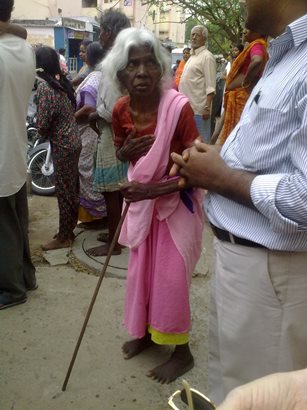
Kuthi Muthu was with the church at Lock Street for as long as I can remember. In her younger years, she was married to leper and bore him eight children, yet she never contracted leprosy.   I can’t remember her ever being ill enough to have to go to the hospital.  She was a winner.  Unfortunately she and her husband did not rear their children in the Lord because they did not know about the church until the children had grown up.

Age 80
Age 80

As she aged and became a widow, she sometimes spoke of being cold during the rain season.  That complaint was easy to understand, because I too felt the cool dampness even in my house during the monsoons.  I gave her a sweater and hoped it would warm her.  Then one day she came saying her stomach hurt and she needed help to feel better.  We took her to the local hospital where she was admitted for a few days for observation.  The doctors there claimed she had cancer and sent her home to die.  Not willing to give up so soon, we took her to another hospital in the area where we were told the same thing, except that these claimed she was too old to treat.

After trying four more hospitals, we finally took her to an elderly lady doctor in the village who had sympathy enough to try to find out what Kuthu Muthu’s trouble might be.  The diagnosis was related to her feet and legs and she she was treated for tropical Filariasis (sometimes called elephantitis). It obviously affected her stomach too.

A younger teacher at CTTS volunteered to carry her breakfast every morning along with the prescribed tablets for treatment.  The medicine was harsh and she seemed to grow weaker and sicker quickly.  The young man continued to monitor her and give what the doctor prescribed.  One day she fainted and sustained a rather nasty bruise and cut to her head.

In all this, Kuthi Muthu never wanted to miss an assembly of the saints.  Even when she was so sick she could not walk, she asked for someone to carry her to the meetings.  Likely because she thought her time was near, she came bringing a cloth bag filled with wadded up rupees (Indian money) and requested to be able to donate that to the church one day.  Some covetous soul who heard about her gift berated her and said, “You should  have given that money to your children!”

Her children…ah, yes, those eight she bore to the leper…those eight who were not members of the Lord’s body because they had been reared in paganism…those eight who couldn’t wait to occupy her house…

Not one of them wanted to take care of her in her old age!  Mind you a son and his family had moved into her house–supposedly for that purpose, but they would not even give her a cup of tea in the mornings, nor would they feed her anything but waste food.  Students and teachers from CTTS took it upon themselves to be sure she ate three meals a day and had the medicine she needed.  We could not assume her family would allow her access to good food or medicine even if we sent it there, so this had to be part of our personal daily ministry.  It was literally a trip to find her three times a day and give her what she needed–our chance to be used by the Lord to visit the widow in her affliction…(James 1:27).Kuthi Muthu at 84

Finding Kuthi Muthu was not always easy.  She learned early to avoid the brutality at home, so she walked, and walked, and walked from morning until late at night. There were times we found her on the roof top of her four story apartment building.  She lived on the third floor, so going up one more floor by the stair was nothing to her.  Later, when someone blocked the stairs, she used the metal ladder bars outside the apartments to climb all the way up the apartment walls.  She said sitting in the summer tropical sun was better than listening to the fighting in her home (Prov. 21:19).  One day she complained about never having a chance to rest in her own house and cried about the treatment she was getting.  Someone asked her if that gave her a chance to return good for evil, and she agreed it did (Matt. 7:12; Luke 6:31).  She was willing to be defrauded (1 Cor. 6:7).

There were so many trials during those last years, but Kuthi Muthu seemed to conquor her temptations and remain strong.  We too had trials along with her and were often tempted to give up, but the journey was a blessing for all of us.  She passed from this life last month and many will miss her sweet, yet strong will to do what was right.