Our Centenarian is Gone

Kuthi Muthu was with the church at Lock Street for as long as I can remember. In her younger years, she was married to leper and bore him eight children, yet she never contracted leprosy.   I can’t remember her ever being ill enough to have to go to the hospital.  She was a winner.  Unfortunately she and her husband did not rear their children in the Lord because they did not know about the church until the children had grown up.
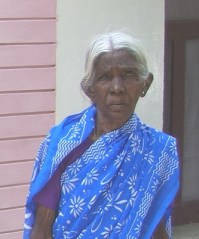
Age 80
Age 80

As she aged and became a widow, she sometimes spoke of being cold during the rain season.  That complaint was easy to understand, because I too felt the cool dampness even in my house during the monsoons.  I gave her a sweater and hoped it would warm her.  Then one day she came saying her stomach hurt and she needed help to feel better.  We took her to the local hospital where she was admitted for a few days for observation.  The doctors there claimed she had cancer and sent her home to die.  Not willing to give up so soon, we took her to another hospital in the area where we were told the same thing, except that these claimed she was too old to treat.

After trying four more hospitals, we finally took her to an elderly lady doctor in the village who had sympathy enough to try to find out what Kuthu Muthu’s trouble might be.  The diagnosis was related to her feet and legs and she she was treated for tropical Filariasis (sometimes called elephantitis). It obviously affected her stomach too.

A younger teacher at CTTS volunteered to carry her breakfast every morning along with the prescribed tablets for treatment.  The medicine was harsh and she seemed to grow weaker and sicker quickly.  The young man continued to monitor her and give what the doctor prescribed.  One day she fainted and sustained a rather nasty bruise and cut to her head.

In all this, Kuthi Muthu never wanted to miss an assembly of the saints.  Even when she was so sick she could not walk, she asked for someone to carry her to the meetings.  Likely because she thought her time was near, she came bringing a cloth bag filled with wadded up rupees (Indian money) and requested to be able to donate that to the church one day.  Some covetous soul who heard about her gift berated her and said, “You should  have given that money to your children!”

Her children…ah, yes, those eight she bore to the leper…those eight who were not members of the Lord’s body because they had been reared in paganism…those eight who couldn’t wait to occupy her house…

Not one of them wanted to take care of her in her old age!  Mind you a son and his family had moved into her house–supposedly for that purpose, but they would not even give her a cup of tea in the mornings, nor would they feed her anything but waste food.  Students and teachers from CTTS took it upon themselves to be sure she ate three meals a day and had the medicine she needed.  We could not assume her family would allow her access to good food or medicine even if we sent it there, so this had to be part of our personal daily ministry.  It was literally a trip to find her three times a day and give her what she needed–our chance to be used by the Lord to visit the widow in her affliction…(James 1:27).Kuthi Muthu at 84
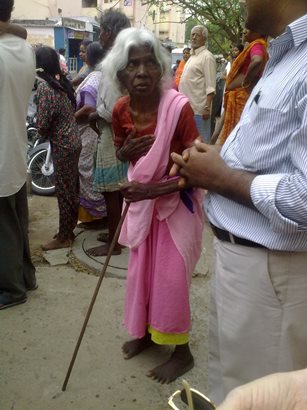
Finding Kuthi Muthu was not always easy.  She learned early to avoid the brutality at home, so she walked, and walked, and walked from morning until late at night. There were times we found her on the roof top of her four story apartment building.  She lived on the third floor, so going up one more floor by the stair was nothing to her.  Later, when someone blocked the stairs, she used the metal ladder bars outside the apartments to climb all the way up the apartment walls.  She said sitting in the summer tropical sun was better than listening to the fighting in her home (Prov. 21:19).  One day she complained about never having a chance to rest in her own house and cried about the treatment she was getting.  Someone asked her if that gave her a chance to return good for evil, and she agreed it did (Matt. 7:12; Luke 6:31).  She was willing to be defrauded (1 Cor. 6:7).

There were so many trials during those last years, but Kuthi Muthu seemed to conquor her temptations and remain strong.  We too had trials along with her and were often tempted to give up, but the journey was a blessing for all of us.  She passed from this life last month and many will miss her sweet, yet strong will to do what was right.

COVETOUSNESS: Lesson 4-Esau Coveted Food

COVETOUSNESS

Lesson 4: Esau Coveted Food


“Lest there be any fornicator, or profane person, as Esau, who for one morsel of meat sold his birthright.  For ye know how that afterward, when he would have inherited the blessing, he was rejected: for he found no place of repentance, though he sought it carefully with tears” (Heb. 12:16-17).


The son of Isaac and Rebekah, Esau was also the twin brother of Jacob. In later life, he was known as Edom, the ancestor of the Edomites (Gen. 25:24-28; Deut. 2:4-8).  His name was given because of the hairy covering on his body at birth: “all over like a hairy garment” (Gen. 25:25). The relationship Esau’s descendants had to those of Jacob was prophesied before the twins were born (Gen. 25:23). Even the moment of Esau’s birth signaled the same destiny (Gen. 25:26).

Scriptural accounts of Esau draw a great contrast between him and his brother Jacob. Esau was a rough, hairy man and a cunning hunter favored by Isaac, while Jacob was a plain man dwelling in tents and favored by Rebekah (Gen. 25:27-28).  Even though he was a twin, Esau was considered to be the eldest son because he was born first. The firstborn was expected to become head of the family, and take charge of the family property.  Naturally he was responsible for the maintenance of the younger sons, the widows, and the unmarried daughters not only as their provider and overseer, but also as their spiritual leader. Furthermore, he generally received the blessing, which placed him in a favored position with the Heavenly Father.

Esau sinned greatly by treating his birthright so casually and selling it for a meal.  In a foolish, impulsive moment, Esau sold his birthright to Jacob in exchange for “bread and pottage of lentils” (Gen. 25:29-34). Later we see he also lost the benefit of his father’s blessing (Gen. 27:36) —two things virtually guaranteed the first born son in ancient oriental culture as well as in the Old Testament scriptures.

After Israel (Jacob’s descendants) became a nation, we see the birthright included a double portion of the father’s assets upon his death (Deut. 21:17).  The inheritance rights of the firstborn were protected by law, so the father could not give his benefits to a younger son (Deut. 21:15-17).  Birthrights and blessings were not the same.  The birthright carried with it the inheritance of property, while the blessing was an additional benefit which the patriarchs usually bestowed upon their children just before their own deaths (Gen. 49:1-28). Even if they spoke by mistake, once a blessing was given it could not be taken back (Gen. 27). 

PONDER THESE THOUGHTS:

Esau basically had his priorities wrong. Like the majority of the world’s population, he was simply living for the moment (1 Cor. 15:32). Unlike Moses who was willing to forsake the temporary pleasures of Egypt for a far greater eternal reward (Heb. 11:24-27), Esau wanted the temporary pleasure of a satisfied appetite.

Esau said, “Behold, I am at the point to die: and what profit shall this birthright do to me” (Gen. 25:32)?  He gave no thought to the consequences of his actions. His decision was illogical, foolish and wicked. The scriptures describe him as being a godless (profane) man (Heb. 12:16-17). We need to learn from him and think very carefully about the consequences of our own choices and decisions. “When thou sittest to eat with a ruler, consider diligently what is before thee: And put a knife to thy throat, if thou be a man given to appetite” (Prov. 23:1-2).  “For the drunkard and the glutton shall come to poverty: and drowsiness shall clothe a man with rags” (Prov. 23:21).

The temporary pleasure of a satisfied appetite has brought many a person to ruin (Prov. 5:3-6). The will of the Father in Heaven; spiritual desires (not the fleshly), the Lord’s church; the righteous commandments of God must come first (Matt. 6:33; Gal. 5:16-24; Psa. 119:172). Esau learned this lesson too late—which is also another lesson for us (Heb. 12:17).  Sometimes the damage can’t be undone. 

The birthright for the oldest child was a special gift from God that he did not give to any but the firstborn. In relation to Christ, God’s firstborn, He showed man that He valued the firstborn above the others. We know how we respond when we offer a very special gift to someone, and they treat it like trash. God offered a very special gift to Esau, but he did not respect nor value God’s special gift—he treated it as if it were less value than a meal. God did not respond positively to Esau’s scorning His special offering.

Figuratively speaking, the term firstborn stands for what is most excellent. This expression is applied to Jesus in several New Testament passages. All of them point to Jesus’ relationship to His Father and to the Church.  Showing that Christ existed before creation and actually participated in the creation process (John 1:3), He is described as the “firstborn over all creation” (Col. 1:15). His virgin birth is depicted by the expression, “brought forth her firstborn son” (Matt 1:25). The phrase, “firstborn from the dead” (Col. 1:18; Rev. 1:5), refers to Jesus’ resurrection, which assures every Christian they also will have the same resurrection if they obey Him faithfully, even unto death.

QUESTIONS:

1. By inspiration, the Hebrew writer tells what God thought of Esau for selling his birthright.  Give the phrase used and the scripture reference.

2. How often do we covet food to the detriment of our souls and our health too?

3. What was prophesied to be the relationship between Esau’s descendants had to those of his younger brother (Gen. 25:23)?

4. What sign was given as the twins were born that signaled that relationship (Gen. 25:26)?

5. RESEARCH QUESTION: Notice a strong comparison between the two brothers: “And the boys grew: and Esau was a cunning hunter, a man of the field; and Jacob was a plain man, dwelling in tents” (Gen. 25:27).  What is the meaning of the word “plain” (Strong’s number 8535)?  How does this word affect our understanding of the character of Jacob when compared to that of his elder brother Esau?

6. Gen 25:28 says, “And Isaac loved Esau, because he did eat of his venison: but Rebekah loved Jacob.”  Consider the prophecy given to Rachel (Gen. 25:22-23; along with Rom. 9:10-14) and tell which parent might have had some justification for showing favoritism?

7. After Esau realized he had lost both the birthright and the blessing, what did he determine to do (Gen. 27:41)?

8. How did Rebekah determine to save the life of Jacob (Gen. 27:42-45)?

9. What other foolish thing did Esau do to displease God and his parents (Gen. 28:6, 8-9).)?

10. After the meeting between Jacob and Esau more than 20 years later, where did Esau go to live (Gen. 33:12-17)?

11. Jacob and Esau met again (Gen. 35:29)?  What was the occasion?

12. How could a firstborn son lose his birthright (Gen. 25:29-34; Heb. 12:16; Gen. 35:22; 1 Chron. 5:1-2; 1 Chron. 26:10)?

13. Under the Law of Moses, if a man had two wives, and one was favored, could he give the birthright to the elder son of the favored wife (Deut. 21:15-17)?  Why would such a law have been necessary?

14. Give the account of when a different patriarch gave the blessing to a younger son (Gen. 48:13-14, 17-19)?

15. Name the ways Christ was firstborn (Luke 2:7; Rom. 8:29; Col. 1:15; Col. 1:18; Heb. 12:23), and tell how God should respond to those who love (covet) and serve mammon and reject the gift of his Son (Matt. 6:24; Luke 16:13)?

COVETOUSNESS: Lesson 2–Lot Covets the Plain of Jordan

COVETOUSNESS

Lesson 2—LOT COVETS THE PLAIN OF JORDAN

Not much information is given about Lot in the Old Testament scriptures.  Genesis, chapter 13 tells the story of Abraham and Lot and how “the land [between Bethel and Hai] was not able to bear them” because their substance was great.  Also the herdsmen of Lot and the herdsmen of Abraham began to quarrel about where their cattle would graze.

Gen 13:6-12

6 And the land was not able to bear them, that they might dwell together: for their substance was great, so that they could not dwell together.

7 And there was a strife between the herdmen of Abram’s cattle and the herdmen of Lot’s cattle: and the Canaanite and the Perizzite dwelled then in the land.

8 And Abram said unto Lot, Let there be no strife, I pray thee, between me and thee, and between my herdmen and thy herdmen; for we be brethren.

9 Is not the whole land before thee? separate thyself, I pray thee, from me: if thou wilt take the left hand, then I will go to the right; or if thou depart to the right hand, then I will go to the left.

10 And Lot lifted up his eyes, and beheld all the plain of Jordan, that it was well watered every where, before the LORD destroyed Sodom and Gomorrah, even as the garden of the LORD, like the land of Egypt, as thou comest unto Zoar.

11 Then Lot chose him all the plain of Jordan; and Lot journeyed east: and they separated themselves the one from the other.

12 Abram dwelled in the land of Canaan, and Lot dwelled in the cities of the plain, and pitched his tent toward Sodom.

Notice in Gen. 13:8-9 that Abraham was willing to allow Lot to choose the land he wanted and to take whatever was left for himself.  Looking toward the plain of Jordan, before God destroyed Sodom and Gomorrah, Lot saw that it was as well-watered and lush as the Garden of Eden.  Not considering the wickedness of the cities of the plain, Lot chose to dwell near Sodom because his heart coveted the well-watered pasture land where he could feed his cattle (Gen 13:12).  By contrast, we see, “Abram removed his tent, and came and dwelt in the plain of Mamre, which is in Hebron, and built there an altar unto the LORD” (Gen. 13:18).  This action on Abraham’s part is even more magnanimous when we consider the custom of that day regarding elder members of a family as patriarchs.

How did Lot’s covetousness ultimately affect him and his family?  Not long after this incident, we see Lot actually living in the city of Sodom when God determined to destroy it for its wickedness.  In Genesis chapter 18, the LORD and two angels visited Abraham and told him what was in store for the wicked cities.  Begging first for the city to be spared for the sake of 50 righteous, then 40, then 20 and finally 10, Abraham was sorely grieved to find there were not even 10 righteous souls in Sodom and that it most certainly would be destroyed.

In Genesis, chapter 19, the scene changed from Abraham to Lot himself, where two angels visited Lot to warn him to flee with his family before the city is destroyed.  Seeing strangers going into Lot’s home, the men of the city demanded to “know” them.  Because Lot could not control the Sodomites who wished to abuse the two visitors carnally, the angels struck the Sodomites blind to save Lot (Gen 19:1-11).  Lot and his family fled the city. Lot’s wife, however, did not follow the angels’ orders and looked back at Sodom. Because of her disobedience she was turned into a “pillar of salt” (Gen 19:26). Jesus warned, “Remember Lot’s wife” (Luke 17:32) as a reminder of the disastrous results of disobedience.  Even today, the perverted sexual orientation of Sodomites derives its name from this wicked city.

Following his escape from Sodom, Lot and his two daughters lived in a cave near Zoar (Gen. 19:30-38). His two daughters made their father drink wine and enticed him into incest. They claimed to do this because “there is no man on the earth to come in to us as is the custom of all the earth” (Gen 19:31). Out of that union came two sons, Moab and Ben-Ammi, the ancestors of the Moabites and the Ammonites, nations that perpetually gave trouble to Israel and Judah.

Lot’s character appears to be revealed by the major decision which he made when Abraham gave him the choice of land. He chose to pitch his tent with the worldly Sodomites, seeking riches and a life of ease.  He prospered for a while, but this decision eventually led to his humiliation and the tragic loss of his wife and daughters.

=============

QUESTIONS:

1. Who was Lot’s father?  What was the relationship between his father and Abraham?

2. Lot was Abraham’s _____________, who accompanied him from Mesopotamia to Canaan and to and from Egypt (Gen 11:27-31; 12:4-5; 13:1).

3. Why did Abraham not want to quarrel about the pasture land (Gen. 13:8)?

4. What disastrous decision caused Lot to lose his family and everything he had?

5. It would be quite easy for us to condemn Lot totally for his sin of covetousness, but what was God’s view of Lot (2 Pet. 2:6-9)?

6. How does Genesis 19 show Lot was “vexed with the filthy conversation of the wicked…vexed his righteous soul from day to day with their unlawful deeds” (Gen. 19:7).  What other verses in Genesis 19 show Lot’s displeasure with what went on there?

7. What might cause Lot’s wife to look back toward Sodom?

8. Judging between Lot’s reaction to leaving Sodom and his wife’s reaction, who might have been the one to demand the family “pitch toward Sodom?”

9. The two daughters show such a lack of faith in bearing children by their father.  What worldly wisdom guided their actions (Gen. 19:31)?

10. RESEARCH QUESTION:  Genesis 13:10 speaks of the well watered plain of Jordan.  “And Lot lifted up his eyes, and beheld all the plain of Jordan, that it was well watered every where, before the LORD destroyed Sodom and Gomorrah, even as the garden of the LORD, like the land of Egypt, as thou comest unto Zoar.”  Since Sodom and Gomorrah were destroyed by fire, what change has taken place in the appearance of the land area?

ANGER

“Of the Seven Deadly Sins, anger is possibly the most fun. To lick your wounds, to smack your lips over grievances long past, to roll over your tongue the prospect of bitter confrontations still to come, to savor to the last toothsome morsel both the pain you are given and the pain you are giving back—in many ways it is a feast fit for a king. The chief drawback is that what you are wolfing down is yourself. The skeleton at the feast is you.” Frederick Buechner

Likely we all have harbored feelings of anger against someone else because of wrongs we perceive they have done, but when their anger is turned toward us our perception of it is totally different. We may fear or we may think about how foolish they appear. Why is anger such a delicious feeling in ourselves and yet so odious coming from others? Solomon, the wisest man on earth said, “Be not hasty in thy spirit to be angry: for anger resteth in the bosom of fools” (Eccl. 7:9).

Solomon also told us how to defer someone’s anger and turn away the wrath that is causing carnage in our lives. “A soft answer turneth away wrath: but grievous words stir up anger” (Prov. 15:1). We know that tempers only escalate when we answer an angry man the same way he has spoken to us. But what if we are right and he is wrong? Does it really matter that we have our way or prove our point if we lose a friend or drive a permanent wedge in family relationships? Can we not rather take wrong in order to make peace and thus please God (1 Cor. 6:7)?

“The discretion of a man deferreth his anger; and it is his glory to pass over a transgression” (Prov. 19:11).

“He that is slow to anger is better than the mighty; and he that ruleth his spirit than he that taketh a city (Prov. 16:32).

In defense of their anger, many will quote Ephesians 4:26-27 and they will say, “See anger is not a sin, as long as I do not let the sun go down on it.” But these people fail to notice that five verses later, we are told to get rid of anger just like we are told to get rid of other evil qualities in our lives. “Let all bitterness, and wrath, and anger, and clamour, and evil speaking, be put away from you, with all malice” (Eph. 4:31). Would anyone deny that these are all evil qualities?

Later, in his letter to the church at Colossi, Paul wrote, “But now ye also put off all these; anger, wrath, malice, blasphemy, filthy communication out of your mouth. Lie not one to another, seeing that ye have put off the old man with his deeds; And have put on the new man, which is renewed in knowledge after the image of him that created him (Col. 3:8-10).

Let’s all work to rid ourselves of this very deceitful, sinful emotion which men have taught us to use to get our way.

KEEPING VOWS

Some say that keeping vows is “not that big of a deal.” We can see by the recent statistics on marriage and divorce that the marriage vows count for little in today’s society. And what about our commitment to Christ when we were immersed in the waters of baptism? Did we promise to lose our lives for Christ and the gospel? Did we agree that Jesus is our king and Lord? If He truly is our Lord, we must do the things He says (Luke 6:46). I keep hearing from those who claim to be members of the church that the reason they became Christians was to escape pain and suffering and to go to heaven instead of hell. Their mind (attitude) seems to focus on what they can get from God rather than how they can serve Him. They seem to have forgotten they did not create themselves, but that He created them (Psa 100:3; Rom 1:21; Mark 8:36-37).

Judas Iscariot sold his soul for 30 pieces of silver (Mat 26:15). Some today seem quite willing to sell their souls for a high paying job, a new house, a new car, or even prestige or power. Both partners in a household will frequently work seven days a week to lay up treasure here on earth (Luke 12:16-21; Mat 6:26), but they rarely will spend more than an hour on Sunday to “serve the Lord.” Would spending that much time each week make any other commitment prosper? Certainly not, so why do people think it would please their Creator?

Others, claiming to be church brethren, cite family ties or commitments to explain why they have no time to assemble for study or worship or to work for Christ during the week. Maybe they believe they have to spend hours upon hours educating their children or helping them with homework. Perhaps they find it necessary to care for aging or invalid parents, which really should not have to be a choice we are forced to make. Provided we do not let these things stand in the way of our service to the Lord, we can do them with His blessing. Nevertheless, some follow these duties because of their great love for family or because of social pressures put on them. “He that loveth father or mother more than me is not worthy of me: and he that loveth son or daughter more than me is not worthy of me” (Mat 10:37). “If any man come to me, and hate not his father, and mother, and wife, and children, and brethren, and sisters, yea, and his own life also, he cannot be my disciple” (Luke 14:26).

The Scriptures above appear to discourage Christians at times and cause them to want to explain them away rather than to believe and trust them. However, they also need to consider the promises given to those who do trust and obey. “And every one that hath forsaken houses, or brethren, or sisters, or father, or mother, or wife, or children, or lands, for my name’s sake, shall receive an hundredfold, and shall inherit everlasting life” (Mat 19:29).

Christians should remember the account of Hannah in the Old Testament who made a vow to God and kept it. Hannah promised that if God would give her a son, she would lend him to the service of God forever. God heard her prayer, gave her little Samuel and she faithfully kept her promise. Not only did God bless her with a son, but later He gave her three more sons and two daughters (1 Sam 2:20-21). There can be no doubt that the “mother heart” in Hannah made her ponder her choice many times. We know she never forgot Samuel because she made a little coat to give him at the annual feast every year (1 Samuel 2:19). She must have had great joy in remembering Samuel as she stitched.

Dennis and I went home for a brief visit at the end of April and I made a shirt or dress to take to each of our children and grandchildren. Stitching and remembering our times together was my consolation for giving them up to serve in a foreign land, but at the same time I missed the ones left here whom the Lord has given me to take the place of my family (Mat 19:29).