Studying to Learn – Suggestion #1

This is where “the rubber hits the road.”

kejob's avatarfor the invisible

Studying to Learn - 1

One of the biggest things I find daunting about reading the Bible is knowing where and how to start, and what to start on, so when some of the ladies in India asked for lessons on how to study, I wasn’t quite sure where to start on that either. But several people shared some inspiring tips with me.

Uncle Jon said when he was getting ready to go to India with Granddad, as a young man, he felt daunted by how much the brethren there already knew, and concerned that he didn’t know enough to be a teacher. So a few months before he went, he set himself a goal to learn where everything was in the Bible.

  • He said he outlined each book, labeling the major contexts. That helped him remember where certain passages were. For example, 1 Corinthians 13 is in the middle of the context about spiritual…

View original post 1,103 more words

Studying to Learn

What if all daughters accepted their dad’s recommendation for studying they way Kara has?

kejob's avatarfor the invisible

Studying to Learn

When we choose to be a Christian, we are choosing to fulfill God’s expectations of a Christian. One of the biggest of those expectations is that we must know His words. (If we choose to be a doctor, we understand we must learn what a doctor needs to know. If we choose to be a disciple, we understand we must learn what a disciple needs to know.)

John 8:31

Then said Jesus to those Jews which believed on him, If ye continue in my word, then are ye my disciples indeed;

We can’t be a disciple without knowing what our Master teaches! But Satan somehow makes us think that we can be disciples [literally “learners”] without spending much time learning:

  • “I’ve been taught well. I think I already know the important things I need to know.”
  • “I’ve read the Bible before.”
  • “I make sure I read my chapter every day…

View original post 1,973 more words

THE EXTERNAL TESTS: Biblical Accuracy

2 Timothy 4:4
2 Timothy 4:4

THE PATRIARCHS

  • Many want to portray the stories of Abraham, Isaac and Jacob as “out of place” in history.
  • Some have said that the names of the people mentioned in the Bible during this time are mythological names – not real human names.
  • Additionally, they have tried to say that many of the Hebrew words in the Old Testament are “late” words, indicating the Old Testament was written late, and is therefore legend, not history.

THE EBLA TABLETS

  • In 1964, Paolo Matthiae of the University of Rome discovered the city of Ebla in what is modern-day Syria. It appears that the peak of the empire would have been around the time that Abraham lived.
  • In that city, Matthiae uncovered over 15,000 tablets of ancient writing, only a few of which have been translated yet.
  • What has been translated, however, has provided enormous support for the accuracy of Genesis.
  • The Ebla tablets refer to many of the places mentioned in the Bible such as Hazor, Megiddo, Jerusalem, Lachish, Dor and Gaza, proving that these cities were significant around the time of the Patriarchs, just as the Bible indicates. It also mentions Canaan as a geographical area.
  • Eblaite variations of Hebrew names such as Israel, Ishmael, and Micaiah were names used every day not legendary figures.
  • The Ebla tablets use many of the words, which scholars had previously identified as “late,” indicating that these words are actually early words.
  • There is now no reason to think that the Old Testament was not written early!

ABRAHAM’S UR

  • Before the 1920s, there were no references to Ur of the Chaldees by ancient historians, and scholars assumed that Ur was either non-existent or else some obscure village in the desert, with Abraham being just an insignificant nomad wandering around.
  • In 1922, however, Leonard Wooley began to excavate around a prominent ziggurat in Tell el Maqqaya.
  • He had discovered Ur.
  • Ur and the other contemporary Sumerian cities were no mean dwellings of crude-minded man; evidence suggest they built dams and dikes for flood control, irrigation canals, invented a plow with a seeding attachment, the wheel, hot and cold running water and sewage pipes in wealthy homes.
  • The Golden Age of Ur was around 2100 B.C., about a hundred years after Abraham was to have lived as far as we can tell.
  • Abraham wasn’t leaving just a primitive village when God called him out of Ur.
  • The earliest Sumerian literature written in cuneiform suggests that they originally worshipped one God.
  • By Abraham’s time, however the Sumerians worshipped over 5,000 different gods, including by voluntary human sacrifice

WAR OF THE KINGS

  • Gen 14:1 And it came to pass in the days of Amraphel king of Shinar, Arioch king of Ellasar, Chedorlaomer king of Elam, and Tidal king of nations;
  • Gen 14:2 That these made war with Bera king of Sodom, and with Birsha king of Gomorrah, Shinab king of Admah, and Shemeber king of Zeboiim, and the king of Bela, which is Zoar.
  • Gen 14:3 All these joined together in the vale of Siddim, which is the salt sea.
  • Gen 14:4 Twelve years they served Chedorlaomer, and in the thirteenth year they rebelled.
  • Gen 14:5 And in the fourteenth year came Chedorlaomer, and the kings that were with him, and smote the Rephaims in Ashteroth Karnaim, and the Zuzims in Ham, and the Emims in Shaveh Kiriathaim,
  • Gen 14:6 And the Horites in their mount Seir, unto Elparan, which is by the wilderness.
  • Gen 14:7 And they returned, and came to Enmishpat, which is Kadesh, and smote all the country of the Amalekites, and also the Amorites, that dwelt in Hazezontamar.
  • Gen 14:8 And there went out the king of Sodom, and the king of Gomorrah, and the king of Admah, and the king of Zeboiim, and the king of Bela (the same is Zoar;) and they joined battle with them in the vale of Siddim;
  • Gen 14:9 With Chedorlaomer the king of Elam, and with Tidal king of nations, and Amraphel king of Shinar, and Arioch king of Ellasar; four kings with five.
  • In 1918, William Albright wrote an article claiming that Genesis 14 was either borrowed from a legend or made up entirely.
  • Since that time, however, the historicity of Genesis 14 has been proven beyond a doubt.
  • In 1933, 23,000 clay tablets were discovered in the kingdom of Mari on the Euphrates river which prove those very kings did exist, and fought. Albright also discovered archaeological evidence that the cities mentioned in Genesis 14 were at war during that time.
  • Ultimately, Albright changed his position.

THE MARI TABLETS

  • The Mari tablets also provided more evidence that Genesis records an accurate account of real people and places.
  • It makes note of the city of Nahor, mentioned in Genesis 24:10, and identifies everyday names such as Abraham, Jacob-el and Benjamin. These names do not refer to the actual biblical people, but show that these were common names in that time.

SaveSave

SaveSaveSaveSave

SaveSaveSaveSave

SaveSaveSaveSaveSaveSaveSaveSaveSaveSaveSaveSaveSaveSaveSaveSaveSaveSaveSaveSave

HOMETOWN STORE OPEN SINCE 1910

A new generation will celebrate the new direction it has given to one of Clarendon’s oldest businesses when Saye’s holds its open house this Saturday from 8 a.m. to 6 p.m.

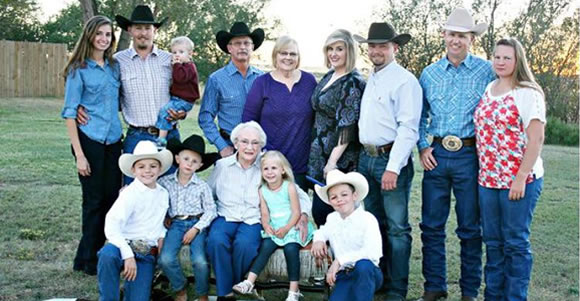
Katie and Josh Fetsch and Savannah Askew, with their kids in tow, are the latest members to operate the family store started by T.M. Little in 1910. The business, now branded as Saye’s Tack Store, carries all types of merchandise that a cowboy needs – ropes, grooming supplies, horse shoeing tools, cinches, blankets, pads, leather goods, and more.

“It’s pretty special,” said Katie, who represents the fifth generation to run the business. “I feel like our family is really close, and it’s nice to continue something that has been in the family and give it new life.”

The Askew family carrying on a tradition of service to Clarendon. Courtesy Photo / Jody Green

What began as Little Mercantile Co. has changed its offerings to adapt to changing times and the needs of each era. Mr. Little’s daughter Emma May introduced a beauty salon – possibly the first in Clarendon – to the business early in its history. She married Carl Saye; and during the Depression, the store moved from its original home, where the Cowboy Church is today, to its present location at 219 S. Kearney between the Burton Memorial Library and Henson’s. At that time, the name was changed to Saye’s Clothing Store, and the business became so varied and carried such a stock, that it operated in its current location as well as occupying the two buildings that make up the city library today.

Another generational change came when Emma and Carl’s son, Tommie Saye, added a photography studio to the business.

Katie’s father, Danny Askew, says the store made an impression on him the first time he came in as a college student in 1974.

“I remember well Tom and his momma following me around like a pair of hunting dogs,” Danny said. “It occupied all three buildings, and you weren’t leaving without buying something.”

After the death of his parents in the early 1970s, Tommie and his wife, Lucy, continued to operate the business but downsized by the end of that decade, selling the north two buildings to the city. The couple eventually shifted the merchandise more towards Western wear, a trend that was continued by their daughter Terry Askew, who took over the business in 1994.

“Each generation changed it a little to fit their time,” Lucy says.

Terry kept the store open regularly through 2010 before going to work full-time at the Best Western Red River Inn. It was still opened though for holidays and special occasions.

“If you consider that T.M.’s mother was with him when he started the store, then we’ve had seven generations walking those floors,” Terry said. “I just love it. I couldn’t be happier that this generation is making it their own.”

Lucy also said that it’s amazing to have this many generations keeping a business going, and she loves how Katie, Josh, and Savannah have repurposed Mr. Little’s original fixtures.

“It’s really great even though it’s completely different,” Lucy said. “The hangers that used to hold dresses now have belts and lariats. And it’s just part of the family history that your children grow up in that store.”

The tack idea for the business really came about last fall, Katie said. Now Flying A Tack is the family wholesale business that travels to Texas, New Mexico, and Oklahoma to service retailers and trade shows. Saye’s is the local storefront for that service.

“There are a lot of people who need these items,” Katie said. “Our local cowboys are awesome, and we love the cowboy community.”

The family invites everyone to Saye’s open house. Activities will include a roping dummy completion, and St. Mary’s Catholic Church will be providing concessions. For information, see their ad in this week’s issue.

BORROWED FROM: http://www.clarendonlive.com/?p=22447

ARE WE OF ONE MIND IN THE LORD OR JUST A CLIQUE?

Are we of one mind in the Lord or just a CLIQUE?

Not many years ago, I listened to a recording of a lectureship forum from FHU where a famous leader in the church said it was neither possible nor even necessary for Christians to agree on every point of doctrine. Then he proceeded to list what he deemed to be cardinal doctrines of the church on which we all should agree.

Below, I have listed several scriptures where the subject of unity is addressed.  Are these inspired words of God simply good suggestions or are they commands we must obey?  Did our Master give us any impossible commands?

  • John 17:21—That they all may be one; as thou, Father, art in me, and I in thee, that they also may be one in us: that the world may believe that thou hast sent me. Was Jesus prayer useless?  Stop for a moment to analyze this verse phrase by phrase to see the necessity for unity.
  • Acts 4:32—And the multitude of them that believed were of one heart and of one soul: neither said any of them that ought of the things which he possessed was his own; but they had all things common.
  • 1 Corinthians 1:10—Now I beseech you, brethren, by the name of our Lord Jesus Christ, that ye all speak the same thing, and that there be no divisions among you; but that ye be perfectly joined together in the same mind and in the same judgment.
  • Ephesians 4:3—Endeavouring to keep the unity of the Spirit in the bond of peace.
  • Ephesians 4:13—Till we all come in the unity of the faith, and of the knowledge of the Son of God, unto a perfect man, unto the measure of the stature of the fulness of Christ:
  • Philippians 2:1-3—If there be therefore any consolation in Christ, if any comfort of love, if any fellowship of the Spirit, if any bowels and mercies, 2 Fulfil ye my joy, that ye be likeminded, having the same love, being of one accord, of one mind. 3 Let nothing be done through strife or vainglory; but in lowliness of mind let each esteem other better than themselves.

Granted there may be some in the church who are bonded by blood, ethnicity or even educational background and so stick together to the exclusion of all others, but genuine Christians should never judge by the flesh!  Now, here is a question for all of us to consider seriously: When/if people in a congregation of the church agree on points of doctrine taught by Jesus (i.e. speak the same thing), should we refer to them as cliques?  The only way for Christians to have true unity is that all speak the same things.  Can we have true unity without the same mind and judgment in Christ?  If someone feels like an outsider, maybe the problem is that he/she is separated by doctrines or practices not yet studied or understood.