I Would Gather All The Words

Sometimes another person can “say it better” than you can. This poem illustrates that very well. Beth

Holistic Wayfarer's avatarA Holistic Journey

If I could I would gather all the words from the wild, pick them like berries     and press them into these pages to     bleed them, beautiful, into my notebook I would chase syllable streams that refresh dry banks and stop. at the quarry where I will cut confused hands on stone,     going through the   ruins of my       dreams and I will bottle my cries to     pour over the altar of my art If I could I would answer the laughter in the wind, unravel the rhetoric of the rain,     and walking dirt and gravel transcribe     the vernacular of city streets I would record every note of joy from children and undo the silence of grandmothers,     ask them   about dogged hope I would keep on west of my despair, right through the dying sun and spell     the sunrise as he lights…

View original post 9 more words

THE HAND OF GOD (Part 1)

Keep in mind what our Heavenly Father says are miracles:

https://helpmeettohim.org/the-hand-of-god/

https://helpmeettohim.org/category/miracles/

THE HAND OF GOD—Part 1

The works of the Lord are great, sought out of all them that have pleasure therein (Psa. 111:2).

O the depth of the riches both of the wisdom and knowledge of God! How unsearchable are his judgments, and his ways past finding out! (Rom. 11:33).

The heavens declare the glory of God; and the firmament sheweth his handywork.Day unto day uttereth speech, and night unto night sheweth knowledge (Psa. 19:1-2).

NOTE:

In this study, we want to distinguish between the miracles (witness of God) and His ordinary work in the world (John 15:23-24). Study each of the following scriptural accounts very carefully (making notes as you go). The following questions can be asked to discern God’s ‘unseen’ work.

  1. What did the people actually see? Was a prophet or an apostle seen doing some miracle? Did the participants see a prophet or apostle do a “miracle,” which was and action beyond man’s natural ability to do?
  2. Did God foretell (through a prophet or an apostle) that certain events would take place which appeared to be from “natural causes?”
  3. Keep in mind:
  4. Take each event in scripture separately and try not to confuse two accounts.
  5. These are plain statements by God about how He works and yet man does not see anything with his naked (physical) eye. The events may appear to be from natural causes to those looking on, but God shows in these accounts that He does them.
  • God’s definition of His witness (miracleJohn 15:24)
  • What He has said was the purpose of His witness to his apostles and prophets messengers (Heb. 2:1-4).

Genesis 11:1-9

1 And the whole earth was of one language, and of one speech.

2 And it came to pass, as they journeyed from the east, that they found a plain in the land of Shinar; and they dwelt there.

3 And they said one to another, Go to, let us make brick, and burn them throughly. And they had brick for stone, and slime had they for morter.

4 And they said, Go to, let us build us a city and a tower, whose top may reach unto heaven; and let us make us a name, lest we be scattered abroad upon the face of the whole earth.

5 And the Lord came down to see the city and the tower, which the children of men builded.

6 And the Lord said, Behold, the people is one, and they have all one language; and this they begin to do: and now nothing will be restrained from them, which they have imagined to do.

7 Go to, let us go down, and there confound their language, that they may not understand one another’s speech.

8 So the Lord scattered them abroad from thence upon the face of all the earth: and they left off to build the city.

9 Therefore is the name of it called Babel; because the Lord did there confound the language of all the earth: and from thence did the Lord scatter them abroad upon the face of all the earth.

Nothing about the confusion of tongues was explicable to anyone involved, but by faith in God’s own testimony we believe He caused it to happen.

THE RESULT OF ABSALOM’S COVETOUSNESS

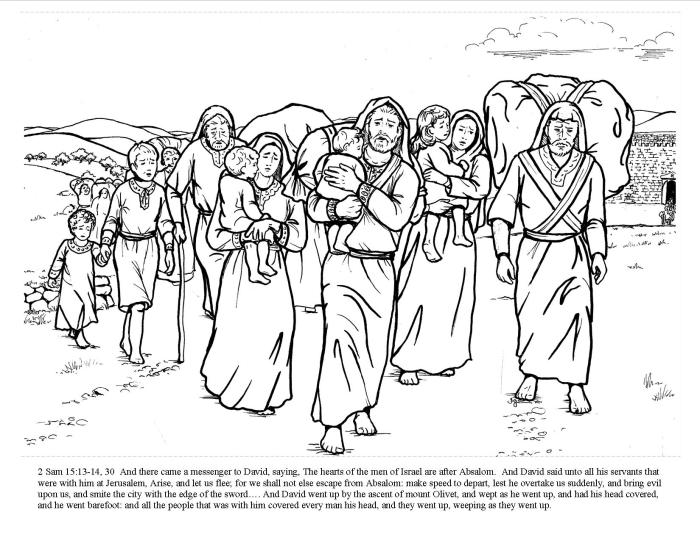
Because Absalom coveted and temporarily usurped the kingdom, David and the faithful subjects were forced to flee Jerusalem.

A Psalm of David, when he fled from Absalom his son:

LORD, how are they increased that trouble me! many are they that rise up against me. Many there be which say of my soul, There is no help for him in God. Selah. But thou, O LORD, art a shield for me; my glory, and the lifter up of mine head. I cried unto the LORD with my voice, and he heard me out of his holy hill. Selah. I laid me down and slept; I awaked; for the LORD sustained me. I will not be afraid of ten thousands of people, that have set themselves against me round about. Arise, O LORD; save me, O my God: for thou hast smitten all mine enemies upon the cheek bone; thou hast broken the teeth of the ungodly. Salvation belongeth unto the LORD: thy blessing is upon thy people. Selah (Psa. 3).

ABSALOM

As Absalom was growing up, he must have been a delight to both his father and his mother. The scriptures say he had physical beauty and personal charisma far beyond anyone else in the kingdom.

But in all Israel there was none to be so much praised as Absalom for his beauty: from the sole of his foot even to the crown of his head there was no blemish in him. And when he polled his head, (for it was at every year’s end that he polled it: because the hair was heavy on him, therefore he polled it:) he weighed the hair of his head at two hundred shekels after the king’s weight (2 Sam. 14:25-26).

His mother was Maacah the daughter of Talmai king of Geshur (2 Sam 3:3). What a delight it would be for any parent to envision the potential of such a child as Absalom. However, it appears that Absalom allowed himself to become proud of his ability or his appearance and that pride eventually destroyed him.

The first glimpse we have of Absalom is when he seeks vengeance for the defilement and rejection of his beautiful sister Tamar (2 Sam. 13:1-39). Another son of David had fallen in love with Tamar and longed for her so much that an evil friend arranged that he should entice her to commit fornication with him. Tamar was not to be enticed by such immorality, so Amnon forced her—afterward casting her away with more vehement feelings of hatred than his first passion for her. Her life was ruined because she was no longer a virgin daughter of the king. The Mosaic Law would have provided punishment for her attacker if only Absalom had obeyed the law and let his father and the priests have time to do their work.

The law made clear that what had been done to Tamar was wrong (see Lev. 18:9-11; compare with Lev. 20:17), but what Amnon did was still not punishable by death because Tamar had not been betrothed to anyone. If he had done the right thing according to the law, he could have married her. No doubt King David as well as the whole nation of Israel were waiting to see whether Amnon would repent and marry the virgin whom he had defiled.

But if a man find a betrothed damsel in the field, and the man force her, and lie with her: then the man only that lay with her shall die: But unto the damsel thou shalt do nothing; there is in the damsel no sin worthy of death: for as when a man riseth against his neighbor, and slayeth him, even so is this matter: For he found her in the field, and the betrothed damsel cried, and there was none to save her. If a man find a damsel that is a virgin, which is not betrothed, and lay hold on her, and lie with her, and they be found; Then the man that lay with her shall give unto the damsel’s father fifty shekels of silver, and she shall be his wife; because he hath humbled her, he may not put her away all his days (Deut. 22:25-29).

When Amnon thrust her away after committing his evil act, Tamar tore her clothes and put ashes on her head to show her grief. She begged Amnon to cover the shame by making her his wife.

And I, whither shall I cause my shame to go? and as for thee, thou shalt be as one of the fools in Israel. Now therefore, I pray thee, speak unto the king; for he will not withhold me from thee (2 Sam. 13:13).

But Amnon did not do his duty by Tamar, nor did Absalom wait for the law to take its course. He took the law into his own hands and killed his brother. Afterward he fled to the protection of his maternal grandfather for the next three years.

But Absalom fled, and went to Talmai, the son of Ammihud, king of Geshur. And David mourned for his son every day. So Absalom fled, and went to Geshur, and was there three years. And the soul of King David longed to go forth unto Absalom: for he was comforted concerning Amnon, seeing he was dead (2 Sam. 13:37-39).

David’s beautiful son did not follow the law, and thus he became a murderer. Who would ever have dreamed that a beautiful son whom David had loved could cause such grief? No doubt David wept for his soul. Not only would David want to be with this son, but most of all he also would want to see him obey the Heavenly Father in order to save his soul. No doubt David mourned more for the folly Absalom had committed than for his absence.

When our children go astray, nobody in the world grieves as much as we do. Nights and days are consumed with tears and thoughts of despair. There is never as much pain over a lost soul as there is for a son or daughter who goes astray.

The next time we see Absalom, is after Joab tricks David into bringing him back into the kingdom. Joab actually pulled a series of tricks to force David to be reconciled with Absalom whether he had repented or not. And once David had given his word (even though he had been deceived), he did not go back on it. David allowed Absalom to return to Jerusalem, where he was able to carry out his treacherous plans.

And it came to pass after this, that Absalom prepared him chariots and horses, and fifty men to run before him. And Absalom rose up early, and stood beside the way of the gate: and it was so, that when any man that had a controversy came to the king for judgment, then Absalom called unto him, and said, Of what city art thou? And he said, Thy servant is of one of the tribes of Israel. And Absalom said unto him, See, thy matters are good and right; but there is no man deputed of the king to hear thee. Absalom said moreover, Oh that I were made judge in the land, that every man which hath any suit or cause might come unto me, and I would do him justice! And it was so, that when any man came nigh to him to do him obeisance, he put forth his hand, and took him, and kissed him. And on this manner did Absalom to all Israel that came to the king for judgment: so Absalom stole the hearts of the men of Israel. And it came to pass after forty years, that Absalom said unto the king, I pray thee, let me go and pay my vow, which I have vowed unto the LORD, in Hebron. For thy servant vowed a vow while I abode at Geshur in Syria, saying, If the LORD shall bring me again indeed to Jerusalem, then I will serve the LORD. And the king said unto him, Go in peace. So he arose, and went to Hebron (2 Sam. 15:1-9).

Finally, the day came when the situation was ripe for Absalom to carry out a coup to take the kingdom away from his father. Even though David had done nothing worthy of such treatment, nor was he an unrighteous king, Absalom obviously despised his father and coveted his position. Perhaps it was envy. Maybe it was pride combined with jealousy, but whatever it was, Absalom was totally wrong to have the loathing for David that he had. Little did he know that God would kill him for his evil against his father.

And there came a messenger to David, saying, The hearts of the men of Israel are after Absalom. And David said unto all his servants that were with him at Jerusalem, Arise, and let us flee; for we shall not else escape from Absalom: make speed to depart, lest he overtake us suddenly, and bring evil upon us, and smite the city with the edge of the sword. And the king’s servants said unto the king, Behold, thy servants are ready to do whatsoever my lord the king shall appoint. And the king went forth, and all his household after him. And the king left ten women, which were concubines, to keep the house (2 Sam 15:13-16).

ABSALOM DEFEATED

David mustered his men and sent out three groups to put down the rebellion. David commanded his soldiers not to harm Absalom. He obviously wanted to spare his life so that there could be time for him to repent. David loved Absalom deeply, and his love caused him to accept shame at Absalom’s hand rather than retaliate. David could easily have put down the rebellion by having Absalom killed, but he would rather suffer wrong at his hand than to cause him to lose his soul in death. Finally, when the news of victory was brought to David, the first thing he asked was for the welfare of his traitorous son.

And the king said unto Cushi, Is the young man Absalom safe? And Cushi answered, The enemies of my lord the king, and all that rise against thee to do thee hurt, be as that young man is. And the king was much moved, and went up to the chamber over the gate, and wept: and as he went, thus he said, O my son Absalom, my son, my son Absalom! would God I had died for thee, O Absalom, my son, my son! (2 Sam. 18:32-33).

The death of Absalom was no comfort to David, because he knew that Absalom was not in a right relationship with God. David would far rather have given up his own life and left Absalom to live, because in life there is hope. In Absalom’s death, there was no hope for his repentance.

What does God think of a child who lifts his hand against his father or mother? For further study, read: Lev. 20:9; Deut. 5:16; Deut. 21:18-21; Deut. 27:16. Finally, consider the very plain New Testament teaching on the topic of respect for the parents God has given us.

For God commanded, saying, Honour thy father and mother: and, He that curseth father or mother, let him die the death (Matt. 15:4; Mark 7:10).

What Does God Call a Miracle?

“If any man speak, let him speak as of the oracles of God….” (1 Peter 4:11)

If we would just remember that, it would save us so much time and error and grief. So many times I have heard discussions among brethren about what a miracle is, and whether we have them today, and we seldom, if ever, look to the Bible for our answers. To the contrary, I hear the “miracle of birth” and the “miracle of the growing seed” (man’s wisdom) mentioned almost every time! Oh! that we had the attitude in 1 Cor. 2:13, “Which things also we speak, not in the words which man’s wisdom teaches, but which the Holy Ghost teaches…!”

What does GOD call a miracle? For instance, many would like to call the act of God healing a loved one in answer to prayer, a “miracle.” What kind of healing in the New Testament times was called a “miracle?” Look at these sample passages: John 4:50-54; John 9:6-16; John 11:43-47; Acts 3:2-7;4:16,22; Acts 8:6-7; Acts 19:11-12. Notice that in every case, where we are told how fast the healing was done, it was instantaneous, and in every case, it was complete and permanent. It is safe to say that the healings today, in answer to prayer, are never like that. They all take some amount of time to come about. They are the natural healings that God has done since the foundation of the world, to sinners and saved alike.

We cannot call every act of God a miracle, because God Himself does not use the word “miracle” in this way. In John 3:1-2, one of the proofs that Jesus was from God was that no normal man could do the miracles He did, unless he were from God, “There was a man of the Pharisees, named Nicodemus, a ruler of the Jews: The same came to Jesus by night, and said unto him, Rabbi, we know that thou art a teacher come from God: for no man can do these miracles that thou doest, except God be with him.” There is no doubt that God is intricately involved, day by day, in the things that happen on this earth. For instance, Matthew 10:29-31 says, “Are not two sparrows sold for a farthing? and one of them shall not fall on the ground without your Father. But the very hairs of your head are all numbered. Fear ye not therefore, ye are of more value than many sparrows.” Every sparrow that falls to the ground is under the care and control of the Father, but God never calls this a miracle. Again, the Spirit says in Acts 17:24-25, “God that made the world and all things therein, seeing that he is Lord of heaven and earth, dwelleth not in temples made with hands; Neither is worshipped with men’s hands, as though he needed any thing, seeing he giveth to all life, and breath, and all things.” Every breath that I draw is an act of God, but it is in no way a miracle, because God does not call it that. “Hath in these last days spoken unto us by his Son, whom he hath appointed heir of all things, by whom also he made the worlds; Who being the brightness of his glory, and the express image of his person, and upholding all things by the word of his power….” (Heb. 1:2-3) The continued existence of the universe is the result of the work of God, but it is not a miracle.

The events that God called “miracles” in the Scripture are things that 1) could only be done thru the aid of the Holy Spirit, 2) were instantaneous and complete, and 3) were done as a witness of the gospel (Heb. 2:3-4). We need to be careful to use words and definitions which the Holy Ghost teaches, and not the ones that men invent. To do anything else is to add to the words of God, and can cause heresy.

–Brett Johnson

HAVE MIRACLES CEASED?

Have miracles ceased? Not too long ago a friend asked, “Where do you preachers get that ALL miracles have ceased?” He later indicated that if miracles have ceased then there is no need to pray for the sick. We hear others make statements like these: “Every time a baby is born a miracle takes place”; and “When a seed is sown and comes up as a plant instead of a seed, that is a miracle.” Some are even teaching today that conversion is a miracle wrought by God on the sinner. That is Calvinism and puts ALL the burden of salvation on God. I understand that one prominent preacher among us is teaching that there is nothing for a man to do in the plan of salvation: it is entirely up to God. That, of course, would mean either universal salvation or else it would be God’s fault any time an individual was lost. Both ideas are absurd and not substantiated by ANY passage of Scripture.

In 1 Corinthians 12-14 Paul deals rather completely with the miraculous spiritual gifts in the church at Corinth. In chapter 13 he uses three examples to show that ALL miracles were to cease. In verse 9-10 he compares knowing in part and prophesying in part (the Miraculous Age) with that which is perfect and complete. Paul said that during the time of miraculous gifts they only know in part. They did not have the complete revelation. But when that revelation was perfected (completed) then that which was in part (miracles) would be done away. In verse 11 Paul compares the period of miracles as childhood and the period of complete revelation as manhood. The church in her infancy needed miraculous spiritual gifts in order to reveal, confirm and teach the precious gospel of Christ. After the complete will of Christ was revealed and confirmed and written down for all ages, there was no further need for those gifts. They passed out of existence. Just as one uses scaffolding in building a building and then removes the scaffolding after the building is completed, the age of miracles served the early infant church as a type of scaffolding until the complete will was perfected, revealed and confirmed. Finally in verse 12 Paul compares the Miraculous Age to looking into a glass darkly, getting only a faint picture. The age following is compared to looking face to face.

Why would anyone want to take the church back to the period of infancy? What purpose would miracles serve today? If one does not believe the Word of God which has been confirmed by miracles, he would not believe in the face of a miracle today either. Much confusion also exists because men do not recognize the definition of a miracle. A miracle occurs when God’s laws are by-passed (as the resurrection of Lazarus) or when something stands in opposition to the laws of Nature (as in the parting of the Red Sea). There may be other definitions that can be added, but this should enable us to see that the birth of a child, the growing of a plant from a seed, or conversion are not miracles; they all occur according to God’s divine laws.

Reader, read the 13th chapter of 1 Corinthians. Study it carefully. You can easily see that all miracles have indeed been done away because we no longer have any use for them. They fact remains that we either have the entire Word of God and thus do not need miracles, or else we do not have the entire Word of God and thus still need miracles today. It is obvious from 1 Corinthians 12-14 that the former is true.

–PAUL M. WILMOTH

DISCLAIMER: I have not been able to contact this man for permission to use his article.  If  anyone knows how to contact him, please let me know.